Embodied Boundaries: When Empathy Becomes the Wound
Housekeeping
Join me tonight at 7pm Eastern for an online, donation-based new moon circle. We’ll be traveling to our hearts for messages on how we can show up in a heart-centered way for humanity. Subscribe today to receive the monthly meeting link!
On to the article!
—
The anxiety rippled through my body like the rolling thunder so prevalent during this summer’s storms here in Virginia: A deep shaking and rumbling, buried within my core, breaking through and moving upward and outward violently. Alarms in my body making my heart race, my breath shake, and my blood pound.
I stopped puttering around the kitchen and just stood there, shocked at the intensity out of nowhere. I’m intimately familiar with anxiety’s dance steps: The invitation to worry, tantalizing me with the promise of a future where I have control over the outcome. The shift from peace into a dance with options that turns into a dizzying merry-go-round of the Viennese Waltz as I fumble over the potential scenarios, tripping through the steps, losing count, realizing how much more I need to take into consideration before overwhelm shuts down my system and I end up in bed for a day with my ulcers angry, my head weighted with lead, and my senses too raw to process even the mundanity of life.
This was different. There was no invitation to the anxiety, no reference to future scenarios, no temptation to plan. Just terror decimating my ability to think, see, hear, or otherwise perceive life. Almost as quickly, it left, only to return a few hours later. It finally puttered out that evening, after I talked with my daughter—who it turns out, had been in the midst of her own dance with anxiety when I began to feel, you know it, her feelings.
—
CPTSD survivors spend most of their lives in a state of hyper-awareness, alert for any sign that a person or their lives are about to explode and rain fire and brimstone. I thought the 20+ years in and out of a variety of therapy meant that I’d (mostly) moved on. That the effects of the CPTSD I deal with had been completely uncovered and documented. I thought I knew all the ways the trauma drove me to seek safety. Not that I necessarily could avoid all my triggers or make it through them unscathed, but I thought I’d at least identified everything. I thought my dataset was complete.
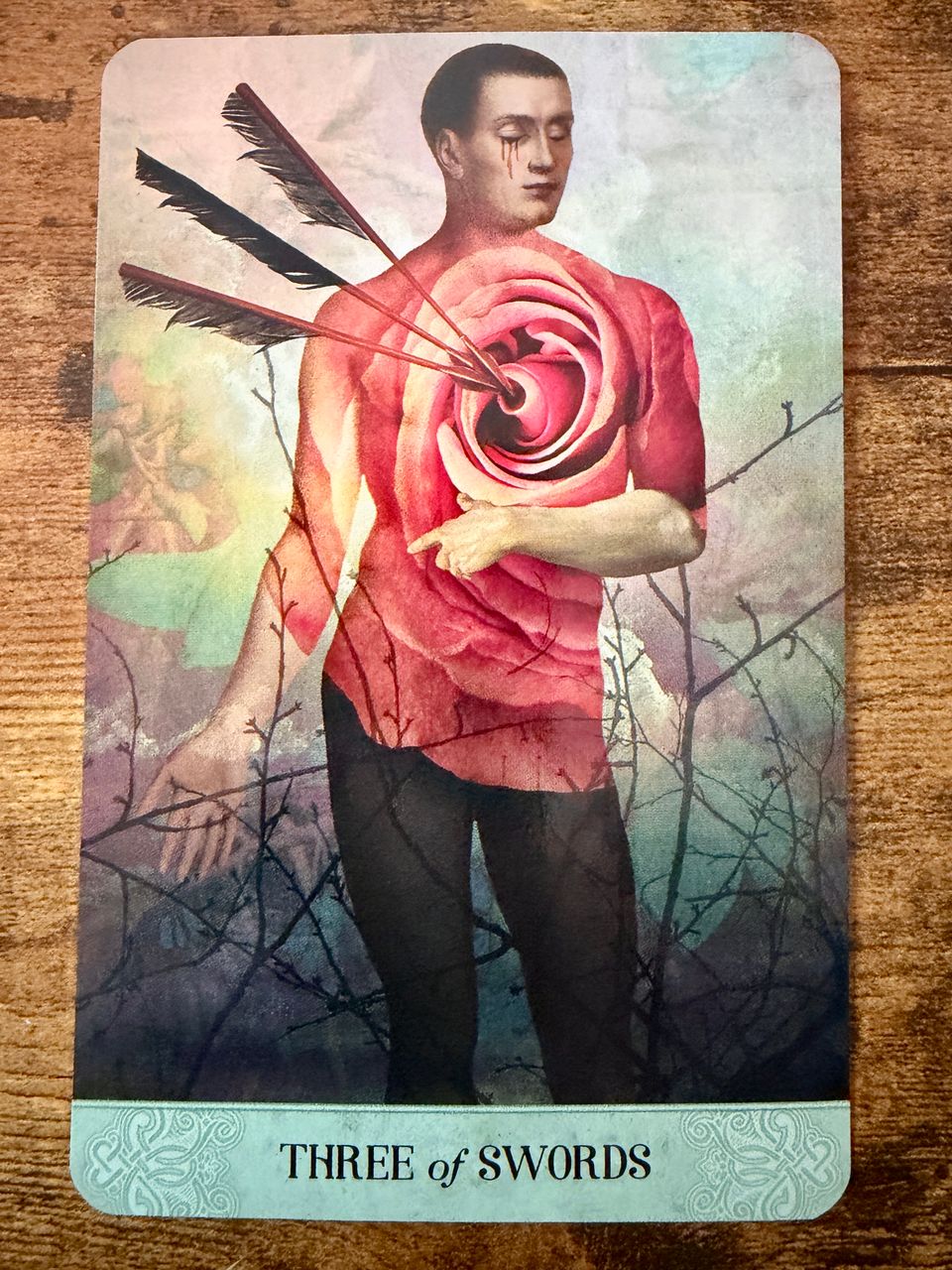
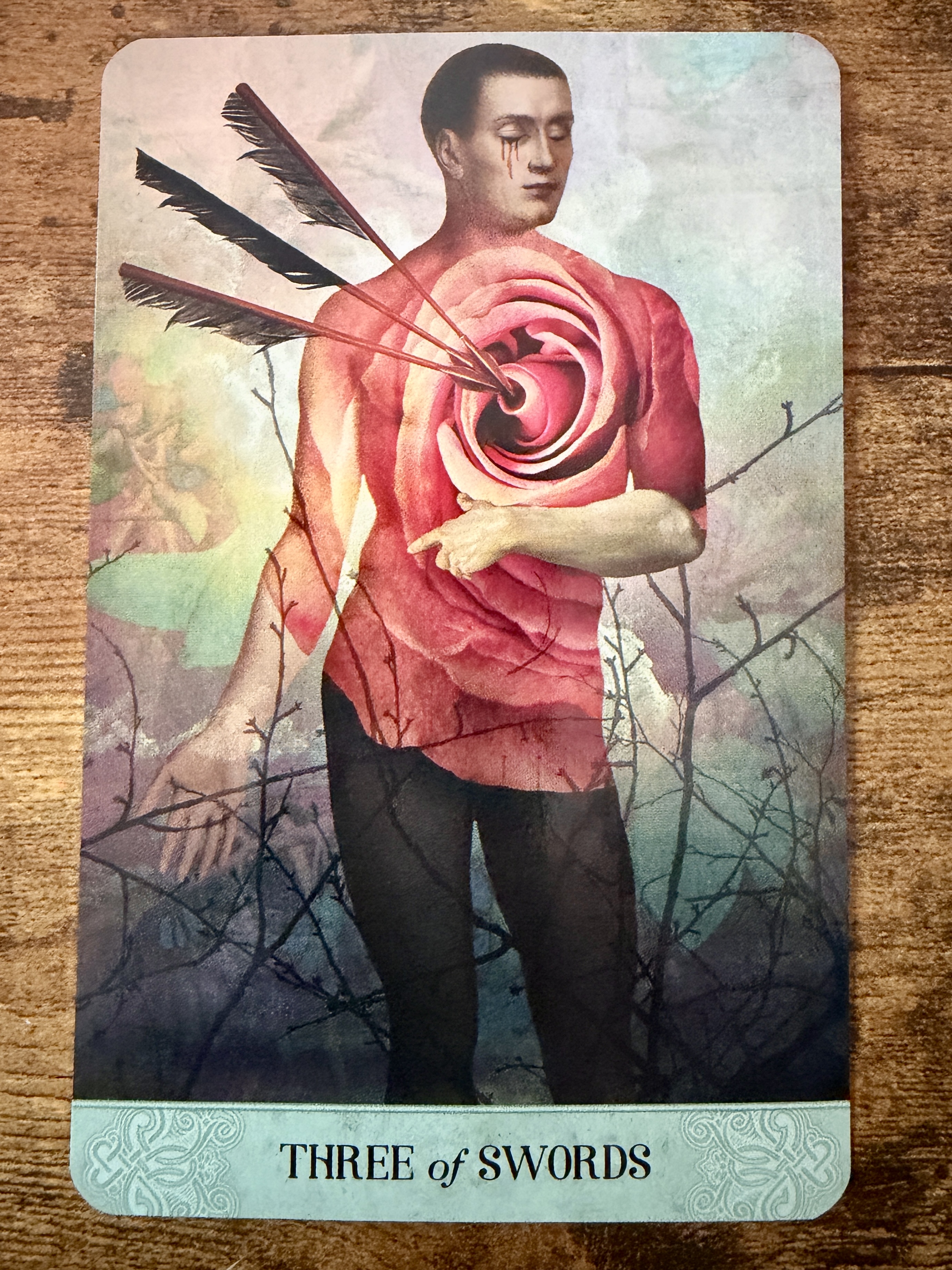
When the 3 of swords began showing up in my readings last week, I started to get worried. What grief or heartbreak would I need to contend with? I know this total solar eclipse in my first house of Leo means I’m more likely to deal with a punctured ego. (And damn, does a punctured ego hurt.)
Chiron has also entered Taurus, where my natal Chiron resides at 4 degrees. Chiron, the wounded healer, in the sign of the body, nearing my natal Chiron return. Ouch. Challenges around wounding about self-worth, the body, safety. Definite 3 of swords energy. Where and how might this manifest?
So focused on the crossroads of my own personal hurts and worries, I failed to take into account the last few months. These anxiety spikes (sometimes sadness, sometimes anger, sometimes heart bubbles of love, and sometimes joy) had been popping up, uninvited, inside me regularly. Even after I reviewed each instance and could accurately connect it to the emotions emanating from someone else, I couldn’t see how this would be related to the 3 of swords.
I’m feeling just fine.
It’s everyone around me who’s feeling like crap.
So why was I getting the heartbreak card?
—
When I began explaining to my wife that I think my body is taking on and reacting to the energetic feelings of her and others as though it’s my own—perhaps contributing to the ulcers that have reappeared in my stomach this summer—she noted that feeling other peoples’ feelings is empathy.
That stopped me for a moment. I’m an empathic person. When I’m reading for a client, I literally feel what’s going on in their bodies and translate it back to them (with help from the Tarot). My intuition is a torch lit by the messages from my body. But that’s not actual empathy is it?
Turns out, it is: It’s “affective empathy,” versus “cognitive empathy.” Feeling the emotions in your body versus understanding the emotions intellectually.
But even if I was feeling affective empathy, I still was confused. Wouldn’t one need an external trigger that your conscious brain was aware of?
These experiences were more like unconscious, energetic, psychic intuition and abilities. Not empathy—something else, something below my awareness.
I’d thought I’d addressed this through my daily spiritual practice which includes building an energetic container every morning, protective boundaries that keep all energies out of my field, except for love and source (and my own emotions).
Apparently, for me, “love” includes feeling what my loved ones feel. All the time. Even if it’s negative emotions.
Crap.
—
Is this a deeper form of bodily CPTSD? Has my body-brain learned to love only by staying acutely attuned to my loved ones’ energies, to the point that it is detrimental to my life?
Yes, my cards say. Yes.
Also: The pathology is irrelevant. What matters is that you must let go of loving in this way.
It’s scary to let this go, to cut away such a vulnerable piece of me. It feels like I would be cutting into flesh without anesthesia. It feels like I’d be doing a disservice to my family. Like I was being selfish. Like I was loving less.
My wife dropped the word “codependency” in the chat. Youch.
I can see that. I can see how my reluctance to change my unconscious hyper-awareness of the energies of my loved ones could be codependency. I was sacrificing my body to take on the emotions of my loved ones.
It’s safety. Right?
If I know how they are feeling, I can drop into a conversation with them and understand immediately. I can provide the type of support I know works best for them. I can show up and show out and be the husband/father I’m proud of. (Doh—there’s the ego!)
That’s really tantalizing for a neurodivergent person who often doesn’t understand why human behave the ways they do.
Plus, it makes me look good. Leo risings love to look good.
—
It’s time for me to take all the theory I know about energetic boundaries and stop removing myself from my mental list of “people who need energetic boundaries.” In a way, I’d subconsciously given myself an exception: I don’t need to put energetic boundaries in place with my loved ones, no way. It’s okay for me to keep these channels open at all times. I am strong; I can handle this.
(Plus, my childhood pounded into me the idea that I, alone, was responsible for the emotions and feelings of my loved one, so duh—of course I wasn’t going to put up boundaries.)
—
Learning and knowing are two different things to me.
When I learn something, I take it in intellectually. I understand the theory.
But knowing?
Knowing is a whole ‘nother level of understanding. Knowing is when your body has experienced a situation, experienced the nuances of how someone else’s anxiety manifests in your field.
I learned—and taught—energetic boundaries.
Now it’s time to KNOW energetic boundaries in every aspect of my life.
Boundaries are not bad.
Boundaries are necessary.
Boundaries are also, apparently, needed internally, not just externally.
These aren’t boundaries I need to set with my family. My family isn’t asking for me to stay open to their energies at all times. That’s on me; that was my (unconscious) choice.
These are boundaries I need to set with MYSELF.
I am safe, even when I’m not hyper-attuned to my people.
I have the tools and resources I need to navigate conversations with people where I am not energetically attuned to their frequencies or vibrations.
It is okay to let go of hyper-monitoring. It’s okay to release the need to stay energetically connected in service of helping.
—
My stomach is in knots even writing the above sentences. This is a real, embodied fear. That somehow, releasing the constant connection will make me less than. Will make me unlovable. Will show the world my shame at being unable to handle the worries of everyone I care for.
There’s also a real, embodied excitement.
Wait, my heart says. Wait. We can actually LOVE BETTER when we aren’t depleted in a state of constant connection?!
(Interestingly, the tinnitus in my right ear also began dominating my senses as I’ve been writing this section. Fear of hearing harsh words. Fear of being judged, or shamed.) (Then my left ear as I edited these paragraphs; our bodies are SO LOUD in their communications sometimes!)
My body is terrified.
My body is ready.
Both-and.
Let’s do this. Let’s learn how to love better.
—
Hawth Reiter is a trans husband, dad, writer, artist, tarot reader, animist, and threshold guide who stands in the liminal crossroads, holding aloft a torch to illuminate possibilities and helping you find the right keys to unlock the gate guarding your path (even if it’s a gate of your own making). Book a session, sign up for monthly new moon circles, or purchase enspelled artwork at HawthReiter.com.
—
AI Use Disclaimer: Claude Sonnet 5 was used as a thought partner to help me come up with the title and subtitle.