Dispatches from an Analog Life: 20 Years of Digital Documentation, Gone
Some time ago — years, at this point — when I realized that maybe cloud-based platforms weren't the best place to store treasured memories, mementos, miscellaneous writings, and more, I bought a hard drive. Over the years, as my disgust with social media platforms grew, I maintained the idea that, someday, I would download all my data from Meta and store it on the hard drive.
That day finally came last week. Sick of the AI slop, sick of the engineered exploitation of my attention span, sick of supporting the billionaire class, I clicked the buttons to download my data and delete my accounts.
Turns out the hard drive I purchased was unusable, even after I hunted down the most recent driver online. It was too old.
Data spanning 20 years, across three platforms: Facebook, Instagram, and Threads — gone. No way to store it externally, off of any cloud system. And a reminder that even if I could, technology is changing so rapidly, there is no guarantee I'd be able to access or view the data on an external hard drive in the future.
As I sat at my desk in desperation, a still, small voice inside reminded me: Nothing in life is meant to last.
Nothing.
Nothing I produce, or you produce, or anything anyone creates is meant to last forever.
Sure, we have some leftover remnants of previous human settlements. Cliff dwellings in Arizona, Stonehenge, so many roads built by Romans. I began to wonder, though:
What do the trees leave behind?
The glaciers?
The mountains?
The nature of life itself is to change.
Death is the sacred polarity of life.
In 1997, my then-husband Davy* was one of 2,601 soldiers who went AWOL from the Army.
Any soldier who is absent without authorization is categorized as “absent without leave.” When you go AWOL, the Army does a cursory search to find you. They check with your apartment manager, your family, your friends. After 30 days, you’re DFR—dropped from roll—and considered a deserter, at least, administratively. Once you're DFR, the Army issues a warrant for your arrest. You earn the legal title of AWOL if you've been court-martialed and found guilty.
It was October. We'd just moved to Tacoma, Washington, where Davy was stationed after deciding to transfer from the National Guard into active duty. The night before he was supposed to deploy on a training mission, I heard him in the bathroom.
The clippers bulldozed their way through his dark locks, releasing curls and sending them cascading down his shoulders, floating and twirling and rolling and free-falling across the expanse of soft green jersey knit stretched across his back. I felt the loss as if it were my own. Standing in the doorway to the bathroom, I watched his face in the mirror as he rid himself of his previous life, his previous beliefs, his independence. As he rid me of independence. Surreptitious, I snagged a few lonely hairs and tucked them in a frosted blue crescent moon-shaped bottle. Maybe by collecting his hair and keeping it safe and secure in the bottle, I would keep him safe and secure. Keep me safe and secure.
I wondered if I could handle six weeks of separation, followed by another nine, then six again. Only two weeks home in between. Contrary to what the Army recruiter in Tucson said, the infantry division Davy was assigned to in Washington state at Fort Lewis spent more time overseas than at home.
“I don't know if I can do this.” My voice was quiet. I married him at 17 to escape my mother. Two years later, the Army threatened to separate me from the only constant in my life, the one person who knew how to keep me sane, how to bring me back when depression and dark emotion threatened to overwhelm me.
“I know.” The clipper maintained its buzz as he trimmed the hair above his ears.
“I don't know anyone. No one will hire me.” In the two weeks since we arrived, toting my childhood piano and his parents' bed in an oversize U-haul truck, I'd applied to almost every retail store in a nearby mall. I hadn't sunk to the lows of fast-food work, not yet.
“I know,” he said again.
I watched the reflection of his green eyes in the mirror. He’s excited to go overseas, I thought. He doesn't care about me; he gets to see the world. Even if it meant he had to subdue his anti-authority streak.
“I don't have to do it, you know.” He ran his hand over his head, checking for any missed sections.
“Do what?”
“Stay.”
“You're in the Army full-time now. You can't just go back to being in the National Guard. Once you're in, you're committed.” I crossed my arms, petulant at the hope he sparked in my chest.
“If you can't do this, if we can't make this work, I'm not going to do it.” He set the clippers down and braced himself against the sink. “We can pack up whatever we can in the Geo and head out.”
“Out where?”
“I dunno. Out. Away.”
I left the doorway, angry at his proposition. We didn’t speak of it again that night.
Early the next morning before the sun rose, I stuck my head in the bathroom where he was brushing his teeth.
“You still think we could do it?”
“Do what?” He asked around the foam in his mouth.
“Go away.” I deflected my eyes. I didn’t want to put him on the spot.
“Really?” He paused in his brushing.
“Really.” My heart raced.
“Okay.”
“Really?” My turn to question.
“Really.” He spit out the toothpaste and rinsed. “Let's do it.”
We spent the next half-hour sifting through the belongings in our luxurious two-bedroom apartment, determining what was important enough to merit space in our tiny car, a hatchback Geo Metro, squeezing what we needed most for our next life into duffel bags and stuff sacks and backpacks. The parking lot streetlamps cast a muted glow over our preparations as the dawn threatened to expose our activity. Up and down the stairs we went, our arms full with the most essential items.
We left behind most of my stuffed animals, although a couple were squished into the back of the car. Our wedding album and mementos stayed behind—our memories of the day and our life together would sustain our marriage more than the physical record of it. The new dishes I bought for the new apartment were left on the new table. The dressers and couch and coffee table and bookshelves—all too much to bring along. We piled his Army-issue gear in the middle of the living room for the Army’s ease in recovering the items.
A few smaller photo books were stuffed into the crevices between the larger gear in the car, all of the various backpacks and hiking boots and sandals and ice axes and weather-proofing wax and plastic camp utensils—the items that would keep us alive on our adventure.
We decided we would finance the trip through cash, taking out as much of the small amount of money in our checking account as we could through the ATM that morning. We also decided we would withdraw as much cash as we could from our credit cards; with a high credit score, Davy had multiple credit cards with high limits. I pushed away any worries about the legality of what we were doing, refusing to consider the irreparable damage we were inflicting on both his and my credit scores. We were going into hiding; the credit card companies wouldn’t find us.
Looking back over the apartment, I felt a slight tug of regret at making the decision in such a hurry that we couldn’t sell everything we weren’t taking, like we had done in Vermont two years earlier. Then, we’d planned our trip back to our parents in Tucson carefully. We’d found a house for our two ferrets and sold our wedding presents and our old car to finance the road trip home. This time, there was no extra money. No clear destination. And we weren’t telling our parents.
I played one last song on the piano—silently, my hands above the keys so I wouldn’t wake the neighbors—and we left.
Going AWOL was, perhaps, the most drastic change in my life when I left objects behind; however, between 1995 and 2002, we moved about every six months, often leaving behind whatever detritus we'd accumulated as we'd find ourselves making our way back home to Tucson, Ariz., where we had met and both had family. We'd lived in Vermont (near Burlington), Mammoth Lakes, CA (twice), Lake Tahoe (one crazy summer, living out of our truck in the forest and bathing in the lake before going to work at Burger King), Upstate New York (during the AWOL trip; living in the woods with snowfall is no joke), and a few other towns in Arizona along the way, with Tucson as the home base between trips. We landed in Tucson a final time, in 2002. A newborn baby kinda cramped our nomadic lifestyle.
Each move meant a necessary shedding; I often likened it to a snake shedding its skin. I liked the rhythm and routine of regularly discarding, selling, recycling, or giving away whatever wasn't absolutely necessary for us to survive. If it didn't contribute to eating, sleeping, or an outdoor life, it wasn't kept.
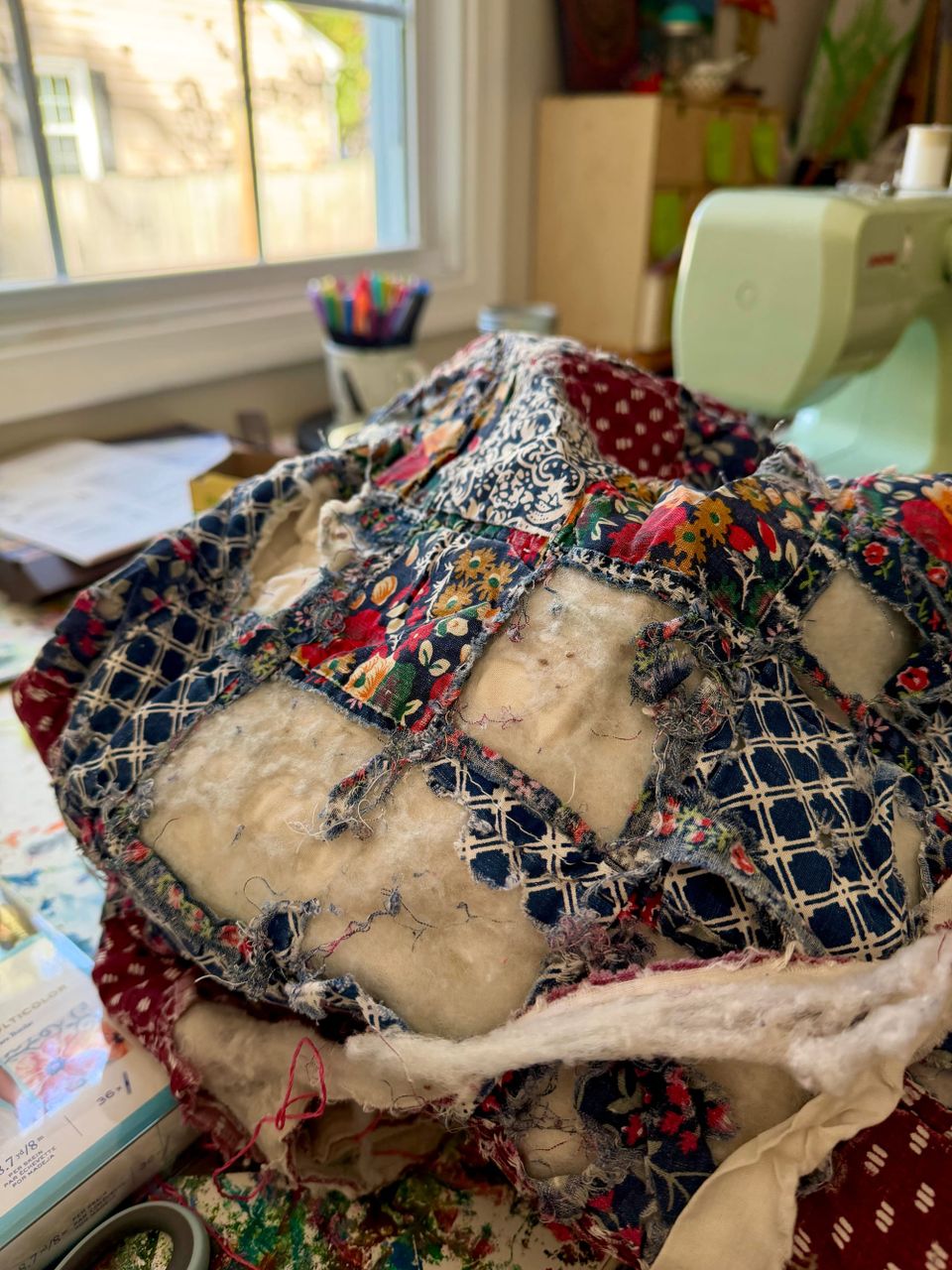
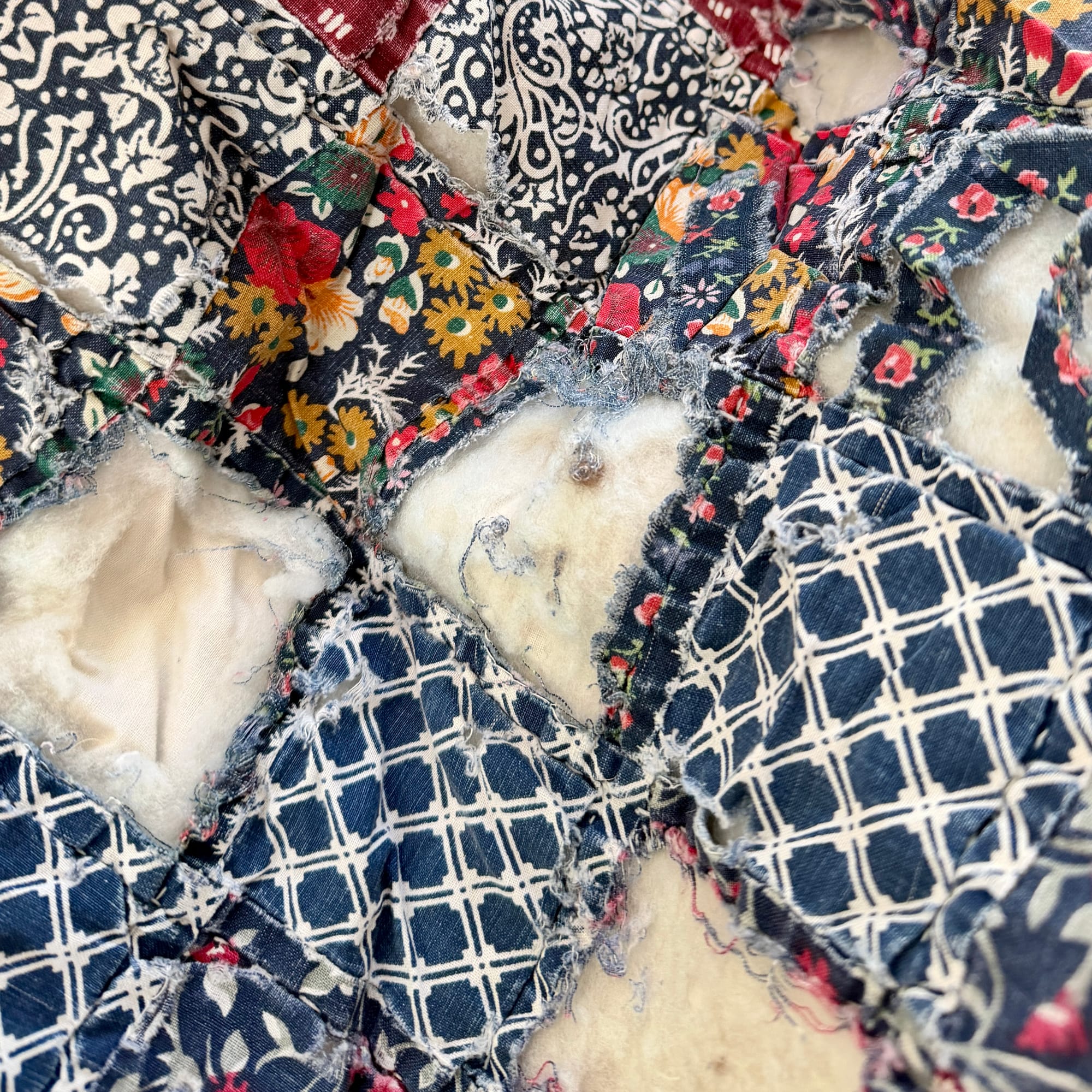
Precious few items remain in my possession from this time in my life. Last I heard, my childhood piano was given to an aunt's best friend's kids. It may have taken a decade post-divorce, but my wedding dress from that 1995 marriage landed in the dumpster in Tucson one hot, humid summer morning when I was ready to release it, along with that blue moon bottle with Davy's hair; I was ready to let go of my former life's responsibilities, duties, and obligations. There is still one item in my possession — a quilt, given to me and Davy on our wedding day as an heirloom. Davy and I are no longer together, but I still have that quilt. It lived in my car, post-divorce, pulled out for picnics and park playdates. It's starting to tatter in places.
Nothing lasts forever.
Some things can be mended, though, to extend their life.
2027 will be the year of the quilt. The year I take that old, torn-up and decaying quilt, and mend it, using upcycled materials and visible mending techniques to turn it into something new. A piece of art that captures my life, with scars and mending for all to see. With too many colors and shapes and textures layered on top of one another, like the stratigraphy of my life. A palimpsestic object of symbolism, of hope, of warmth and wear.
Who knows what it'll end up looking like.
And that doesn't really matter, not in the long run; eventually, the quilt will be gone, too. Like the silent song I played above the piano keys thirty years ago, art doesn't need to be witnessed to exist. To leave its mark on me.
Understanding that 20 years of digital life — images and posts of birthdays, anniversaries, vacations, good food, art I'd made and overmade and remade, too many selfies to count — wouldn't be saved shook me at first. Yes, I'll be taking artistic liberties with mending the quilt, creating a collage that symbolizes my life and values, but that's simply a representation, not documentation.
There would be no photo albums of images that I posted but never saved to a digital camera roll. There would be no scrapbook documenting major milestones in my child's life. In one moment, it all disappeared, from ice into water into steam, evaporating in this sun-drenched, climate-changed world.
I think I'm okay with that.
I'm okay to let that past go. It's okay to close the door on that life, the digitally social life.
Maybe we aren't meant to leave behind permanent records evidencing our existence, whether personally or globally. Maybe I don't need physical evidence of the experiences I've been through, a tangible documentation that I was here, I was alive, I existed, I had fun and I raised children and I had good times and bad.
It's only been a few days post-Meta, and I'm already noticing a difference. I'm reaching out to snuggle with my wife more. I'm engaging with our five-year-old more often; in fact, I'm usually seeking them out more than they are seeking me (and that's saying something, given they're a kindergartener with separation anxiety). I'm watching the birds in the trees behind my home even more often, researching what I see so I can better understand the language of the physical world around me.
Sometimes, my brain stutters and skips. I reach for my phone and then realize there isn't any app on it to distract me. Or I'm tired of the few game apps I still have. I'll read some Substack articles, but it's not the same as short-form videos or conversations that weave together on Threads. Boredom — something I haven't felt in years — arrives with regularity.
And I'm scared of not reaching as many people anymore — without social media, how do I advertise the spiritual work I do? How do I reach people with the messages my guides want me to disperse? Sure, I have this newsletter, but all of 55 people subscribe, and on this new platform, I'm pretty sure the newsletters are going to most people's spam folders. I won't be posting snippets of this article across many social sites, hoping to attract more subscribers. What if my subscriber list evaporates like my memories and data from Meta?
I'm trusting the universe and my guides. I'm trusting that I'm not the only one ready to release the collective attention from the draining energies of social media as it's currently engineered. The more of us that leave, the more we'll find out here in the physical world, the tangible world. I'm trusting that the messages my guides want me to disperse will float on the wind like dandelion seeds, landing where they can take root and add the beauty and joy of yellow flowers, the hopes of wishes on white seeds, and the necessary bitterness of dandelion leaves to help purge metaphysical digestive systems.
I may not have access to the external documentation of what happened to me, what my life was like, how I lived and what I did and the happy and the sad moments that make us human, but I do have access to the internal documentation: My own body. My own thoughts.
Shaped like a mountain carved by a glacier, my body holds memories of safety and love and laughter.
Sinewy and braided like streams through a meadow, my thoughts travel neural networks fashioned over time and through experiences.
Like a snake shedding its skin, I'm freer, lighter, and paradoxically, more prepared by leaving the digital social world behind.
I'm ready for my next chapter.
Are you?
*Name changed.
Hawth Reiter is a trans husband, dad, writer, artist, and threshold guide operating in the liminal. Learn more or book an intuitive reading at HawthReiter.com. Oh yeah, and if you like what you read, please subscribe and/or forward this email! Who knows where this dandelion seed will land and whose life it may change.